
Summary: The Business Case in Brief
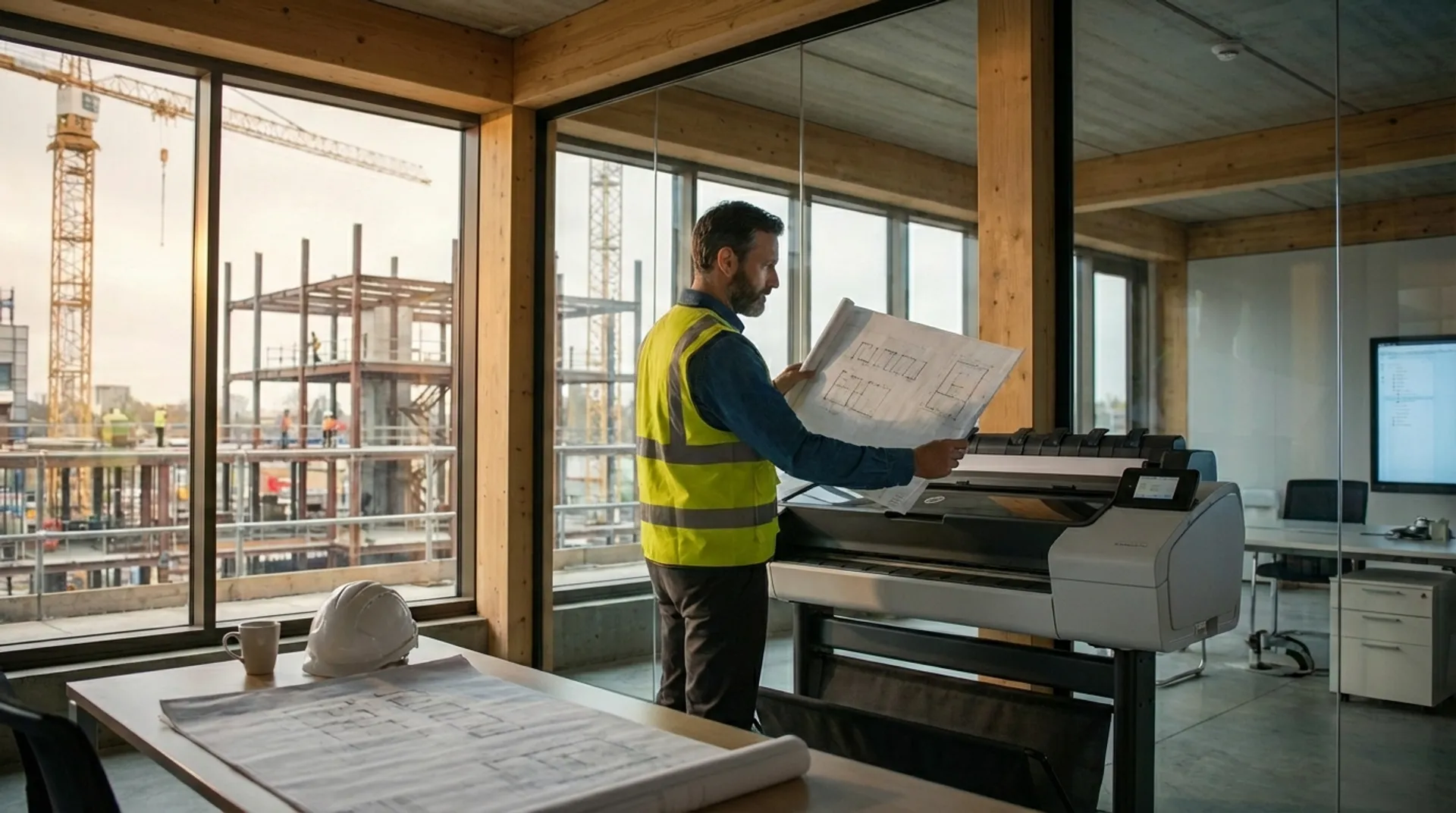
For years, the site office was a simple, dusty container with a table, a coffee maker, and a wall pinned with outdated, coffee-stained drawings. Communication between “The Headquarters” (where the BIM model resides) and “The Construction Site” (where the real work happens) was slow, asynchronous, and extremely error-prone. In 2026, the site office is rapidly transforming into a Digital Hub. The modern site manager is a data manager: they work with an iPad Pro, BIM models live in the cloud (Autodesk Construction Cloud, Dalux), and drones for daily inspections. Does this mean the plotter is disappearing? On the contrary. The role of large format is fundamentally changing: from a “static output machine” to an “interactive collaboration tool.” The primal need to stand around a large plan with subcontractors, the foreman, and the architect and point things out (the “huddle”) persists. A 10-inch tablet screen is simply too small to discuss a complex installation node with 5 people at once. The solution we see at leading construction companies is the hybrid way of working: Large Format Touchscreens (like on the HP DesignJet T2600dr MFP) that function as both a central computer and a printer.
The Hybrid Workflow: Paper and Digital, Hand in Hand
The “Paper vs. Digital” debate is outdated. It is “Paper AND Digital.” Paperless construction is currently a utopia, but “Less Paper,” “Fresher Paper,” and “Smarter Paper” is a hard reality.
1. The Digital Plan Board (BIM on the Wall)
The HP DesignJet (e.g., the Rowe Scan 450i) T2600 MFP has a huge 15.6-inch touchscreen (comparable to a laptop, but vertically integrated).
- Cloud Integration: The site manager logs directly into platforms such as Autodesk Construction Cloud, BIM360, Dropbox, or OneDrive right on the printer.
- Live Preview: They open the latest, approved revision of the drawing on the large screen.
- Visualization: They zoom in, rotate the drawing, check details, and read comments placed by the architect an hour ago.
- Verification: Is this the right version? Yes. Has the reinforcement change been implemented? Yes.
- Print on Demand: Only then do they hit print. Just the part of the drawing needed today (for example, “3rd-floor detail axis A-F”).
- Benefit: This prevents “Version Conflict” (building from an old drawing found lying around), which is the number one cause of failure costs in construction.
2. Scanning and As-Built Documentation (The Feedback Loop)
During construction, things always change. Theory (BIM) clashes with practice. A pipe must be rerouted because of an unexpected concrete beam.
- Past: Someone would scribble with a red pen on the paper drawing. That drawing would get lost in the mud, left in the plumber’s van, or used as a placemat. The revision plan was never updated.
- Now: Someone draws with a red marker on the printed drawing during the huddle in the office (“Redlining”). “This is where the pipe should go.” Everyone agrees.
- Direct Scanning: Then, they walk to the MFP and scan this marked-up drawing directly on site.
- Cloud Upload: The scan goes directly to the cloud folder of the drafting room or the Project Manager.
- Real-time Update: The architect has the change on their screen 5 minutes later and can adjust the BIM model. “As-Built” documentation is updated in real-time, instead of at the end of the project (when everyone has forgotten exactly what was changed).
Business Fundamentals: Failure Cost Reduction & Risk Management
Failure costs in construction still amount to a shocking 5% to 10% of turnover according to various studies.
- On a 1-million-euro project, that’s €50,000 to €100,000 wasted due to miscommunication, demolition, repair work, and delays.
- A full “Smart Site” setup (a good HP T2600 MFP, a fast 5G/Starlink connection, some sturdy tablets) costs maybe €5,000 to €8,000 extra in hardware for the duration of the project.
- If this investment prevents just one major construction error (wrong pile, forgotten sleeve, pipe through a beam), the Return on Investment (ROI) is immediately 1000%.
- Additionally, it provides peace of mind. No more “who had which drawing” arguments, because everything is logged.
The Future: Site Printing Robots?
Digitalization doesn’t stop in the site office. We are seeing the first commercial experiments with HP SitePrint, an autonomous small robot that independently prints layout lines on the concrete floor.
- Instead of a surveyor spending days on their knees with a tape measure, chalk, and a “Total Station,” the CAD file is loaded into the robot.
- The robot drives across the floor at night and prints walls, doorways, pipes, and electrical points directly onto the floor with millimeter precision.
- This increases layout speed by a factor of 10 and eliminates human measurement errors.
- This is the next step for the digital site. Europlan follows these developments closely and advises leaders in the Belgian construction sector on these innovations.
Europlan Service: Rental and Project Setup
For temporary projects (e.g., a 9-month site), buying isn’t always practical (depreciation, transport, storage after project).
- Europlan offers flexible short-term rental (Short lease) of plotters and scanners specifically for sites.
- This is an All-in concept: including installation, 4G router if needed, ink, transport, and on-site service (within 4, 8, or 24 hours).
- We pick up the machine when the project is finished and the site office is removed, ensuring data-secure erasure (GDPR).
- This way, you always have a perfectly working machine without the burdens of ownership.
Conclusion: Paper and Digital are Friends
Don’t dismiss paper as “old-fashioned.” Paper is a “High Resolution, High Contrast, Battery-Free, Glare-Free, Collaboration Display” that always works—even in bright sun, without Wifi, and with dirty construction gloves. Combined with digital tools, it remains the most powerful instrument on the construction site. The modern site office embraces both.
Would you like to modernize your site offices and reduce failure costs?
See also
- The Mobile Site Manager: How to scan and share construction plans directly from the site
- Mud, Rain, and Dust: Which large format printer survives your site office?
- Product/Solution: discover our AEC solutions
View our mobile MFP solutions and rental options for construction