
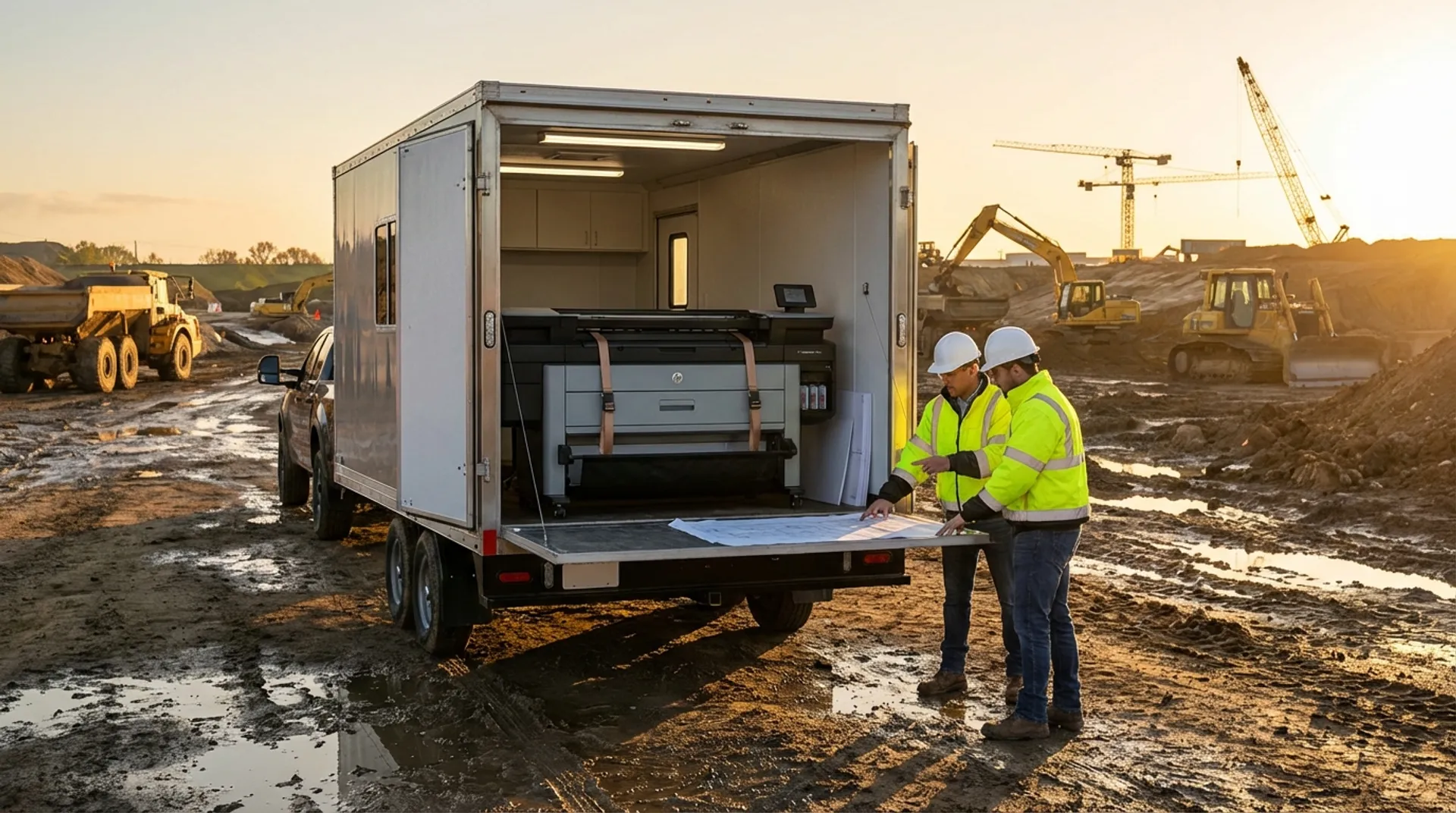
Summary
In large infrastructure projects such as roadworks, pipelines, railway construction, or dikes, the site travels daily with the progress. A fixed construction hut with broadband internet and power is often not available, or is located kilometers away. Yet the need for up-to-date, detailed plans on A0 format is crucial. The solution? A fully self-sufficient, mobile print trailer. Equipped with an HP PageWide XL, power generator, climate control, and 4G/5G connectivity, you bring the complete drafting office to the asphalt, wherever you are.
The Challenge of the “Moving Site”
Take the widening of the E40 over a stretch of 20 kilometers.
- Option A: You set up one central hut at the beginning.
- Disadvantage: Operators drive 20 to 40 km back and forth daily to get a plan. Time loss: gigantic.
- Option B: You order prints from an external repro house.
- Disadvantage: Waiting times, courier costs, and (worse yet) you work with outdated versions because the new plans are “still on the way”.
- Option C: The iPad solution.
- Disadvantage: Just try to read a detailed cross-section of a bridge railing on a 10-inch screen in the full sun or pouring rain. Details are lost.
None of these options is efficient or fail-safe. The physical distance between the data (office) and the execution (asphalt) is too great.
The Solution: The Mobile Print Trailer
Europlan converts trailers into mobile print rooms (in collaboration with specialized bodywork builders). This is not a simple trailer with a printer thrown in. It is a conditioned working environment.
1. The Machine: Why HP PageWide XL?
For mobile use, there is only one king: the HP PageWide XL (e.g., 4200 or 5200 series). Why not a cheaper T-series?
- Speed: 10 to 30 A1 pages per minute.
- You arrive in the morning, start the machine, and while you make coffee, it prints a complete specification of 100 pages.
- This is crucial: you don’t want to wait in a trailer.
- Robustness (Stationary Printbar):
- In a traditional plotter (Inkjet), the printhead swings back and forth at high speed. This mechanism is sensitive to shocks and vibrations during transport.
- With PageWide, the printhead (the Printbar) stays still across the full width (101.6 cm). Only the paper moves underneath it. Fewer moving parts = fewer malfunctions due to transport.
- Pigment Ink: The prints are naturally water-resistant and lightfast. Ideal for outdoor use.
2. The Scanner on Board
The PageWide XL is also an MFP (Multi-Function Printer).
- Digitization: You directly scan in drawn changes (“As-Built”) from the subcontractor.
- Width: The scanner processes maps up to 91.4 cm or 106.7 cm wide lightning fast.
- Quality: Thanks to CIS technology and LED lighting, folds and creases are also well-lit.
The Technology in the Trailer
A printer in a trailer requires adjustments.
- Power Supply:
- Autonomous: A built-in whisper-quiet generator (diesel/gasoline) or a heavy battery pack (Li-Ion) with inverter.
- Solar Panels: Solar panels on the roof of the trailer can recharge the batteries for the lighting and laptop.
- Climate Control:
- Printers hate condensation and freezing cold. The trailer is insulated and equipped with a (parking) heater and ventilation/AC to keep the temperature and humidity constant (between 15°C and 25°C).
- Connectivity:
- An industrial 4G/5G Router with external antenna on the roof.
- This sets up a secure VPN tunnel to the head office. You see your drives (N:, P:) as if you were in the office.
- Shock Absorption:
- The printer stands on a special frame with air suspension or rubber dampers (“Silent Blocks”) to absorb the shocks of the road.
- During transport, the interior (the drawers and scanner) is mechanically locked with a Locking Kit.
Business Fundamentals: Expensive machine, cheap solution?
A PageWide XL in a custom trailer is an investment of tens of thousands of euros. Is that madness? Let’s calculate.
- Comparison:
- Scenario: A large infrastructure project of 6 months with 3 executors and 1 project manager.
- They drive an average of 1 hour daily (back and forth) to the main hut or copy center for plans.
- Lost hours: 4 people x 1 hour x 120 days = 480 hours.
- Lost labor cost: 480 hours x € 60 = € 28,800.
- On top of that come the failure costs: The operator who does not go driving and works with an old version -> Error in the foundation -> € 50,000 damage.
Conclusion: The mobile print trailer often pays for itself on a single large project. After that, it is “free” to use on subsequent projects or has a high residual value.
Media & Supplies
In the trailer, everything is ready. You are your own copy center.
- Standard Paper (75 g/m²): Rolls of 175 meters long (up to 4 of these giant rolls fit in the PageWide!).
- Tyvek (105 g/m²): For final site plans that remain hanging outside.
- Colored Paper: For temporary signage or specific piping diagrams (e.g., yellow for gas, blue for water).
Europlan Service: We Build With You
This is not a standard product from the catalog. This is project work.
- Advice: Together with the trailer builder, we advise on the weight distribution (tongue weight) and the positioning of the machine.
- Installation: We install the Locking Kit and teach your staff how to safely prepare the machine for transport (“Park Position”).
- Maintenance: We come on site (even along the highway) for periodic maintenance.
Conclusion: Asphalt Doesn’t Wait
In civil engineering, the clock, the planning, and the weather forecast rule. With a mobile print solution, you make yourself independent of logistical nightmares. The right information is always, everywhere, within reach.
Do you have a project that covers kilometers?