
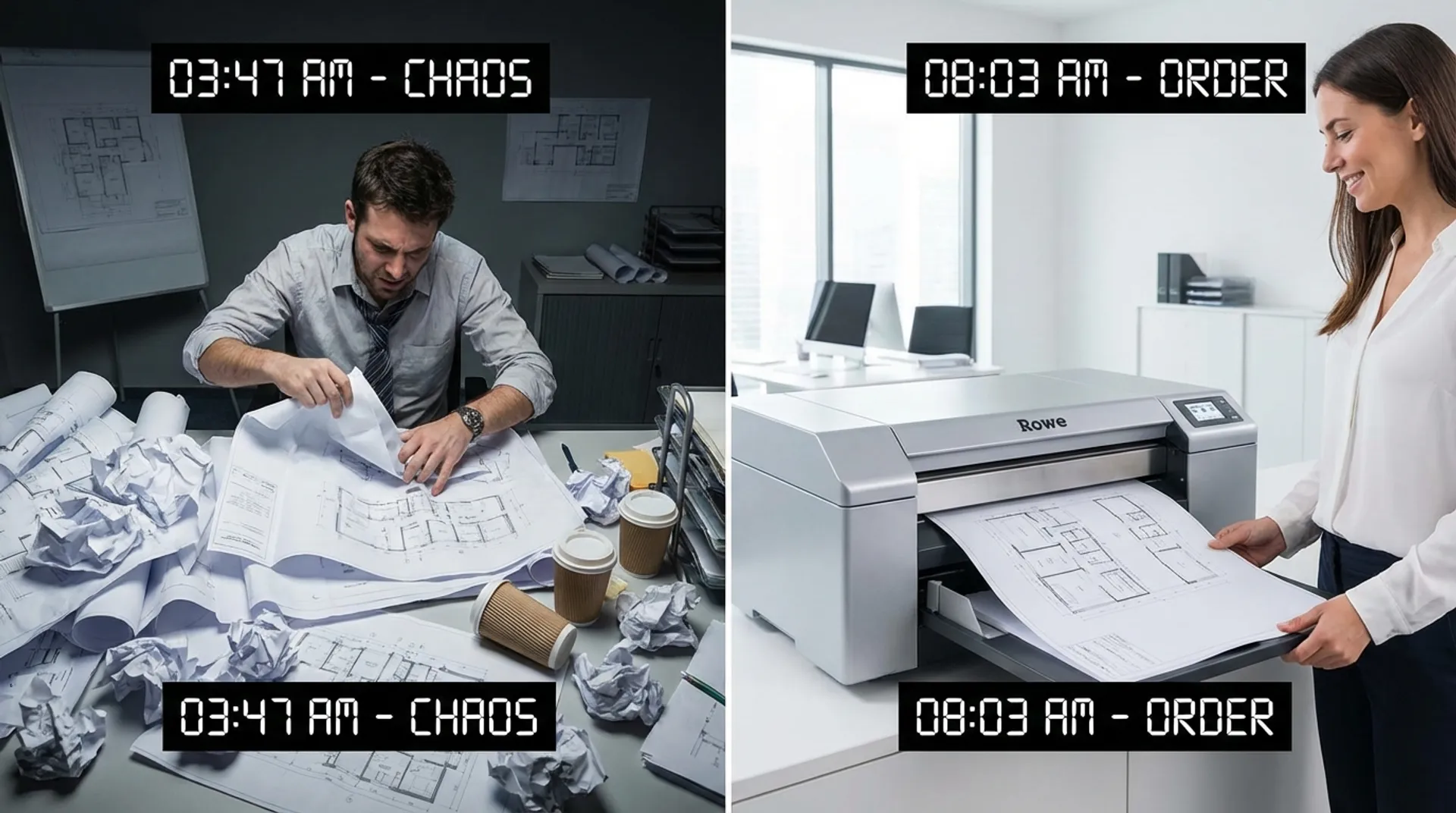
Summary: The Business Case in Brief
The biggest enemy of any complex project is the lack of overview. Project managers work in MS Project, Excel, or Primavera. They create beautiful Gantt charts with thousands of lines: tasks, deadlines, dependencies, and critical paths. They then print this out on A4 or A3. The result: An illegible piece of intricate work. Nobody looks at it. The schedule disappears into a drawer. The alternative is digital projection. But even on a beamer, only a small part of the timeline is visible (“Scrolling blindness”). For large projects (construction, IT, shipbuilding), we see a return to the “War Room” approach: The entire schedule, printed on a roll 3 meters long, on the wall. Everyone sees at a glance where we are, what needs to be finished, and where the bottleneck is.
The Problem of “Compression”
If you try to cram a 52-week annual schedule onto 29.7 cm (A4), you compress time.
- Details fall away.
- The relationship between task A (week 12) and task B (week 40) becomes visually impossible to follow.
- The team loses the “Big Picture”.
The Solution: Banner Printing (Long Plots)
With a roll plotter (such as the HP DesignJet T650 or T1600), you are not bound to A0. You can print infinitely long (until the roll runs out or the software limit is reached, often 15 meters).
- Print your Excel sheet or Gantt chart at 914mm width x 2000mm length.
- Now every day is a centimeter wide.
- Every task is readable without glasses.
- You hang this up in the canteen or the meeting room.
Lean Planning & Sticky Notes
The printed schedule is not static; it is the basis for interaction (Lean Planning / Last Planner System).
- Print the basic structure (the hard deadlines and milestones).
- Have the team stick their tasks on the board with Post-it® notes.
- If a task shifts, you move the sticky note.
- Once a week (during the stand-up), you update the digital file and print a new, clean version.
Business Fundamentals: Visual Management
In the Lean philosophy, Visual Management is crucial. Information must be “in your face”.
- If the schedule is hanging on the wall, no one can say: “I didn’t know I had to deliver today.”
- It creates social control and responsibility.
- It identifies conflicts (“Hey, the electrician is coming in week 4, but the roof won’t be closed by then”). You don’t see this on a small screen; you see it immediately on a 2-meter wide print.
Technical Tip: How do you print long formats from Excel/Project?
Many users struggle with this. By default, Excel wants to divide everything into A4 pages.
- Step 1: In Excel, go to Page Layout -> Size -> More Paper Sizes.
- Step 2: Select the HP DesignJet (e.g., the T830 MFP) driver.
- Step 3: Create a “Custom Paper Size” (e.g., 914mm x 2500mm). Give it a name (“Project planning 2.5m”).
- Step 4: Under Scaling, choose: “Fit to: 1 page wide by 1 tall”.
- Result: Excel stretches the sheet over its full length without page breaks.
Europlan Service: Software Training
We notice that 90% of users do not know how to set up “Custom Paper Sizes”. Upon installing the printer, we provide short training sessions (“Tips & Tricks”) to your project managers. We show them how they can flawlessly run meter-long schedules from MS Project, Excel, and Primavera.
Conclusion: Hang it on the Wall
A schedule that is not seen does not exist. Make your scheduling physical, large, and unavoidable. It is the cheapest way to align your team.
Would you like a “Cheat Sheet” for setting up long prints in Excel?