
Summary
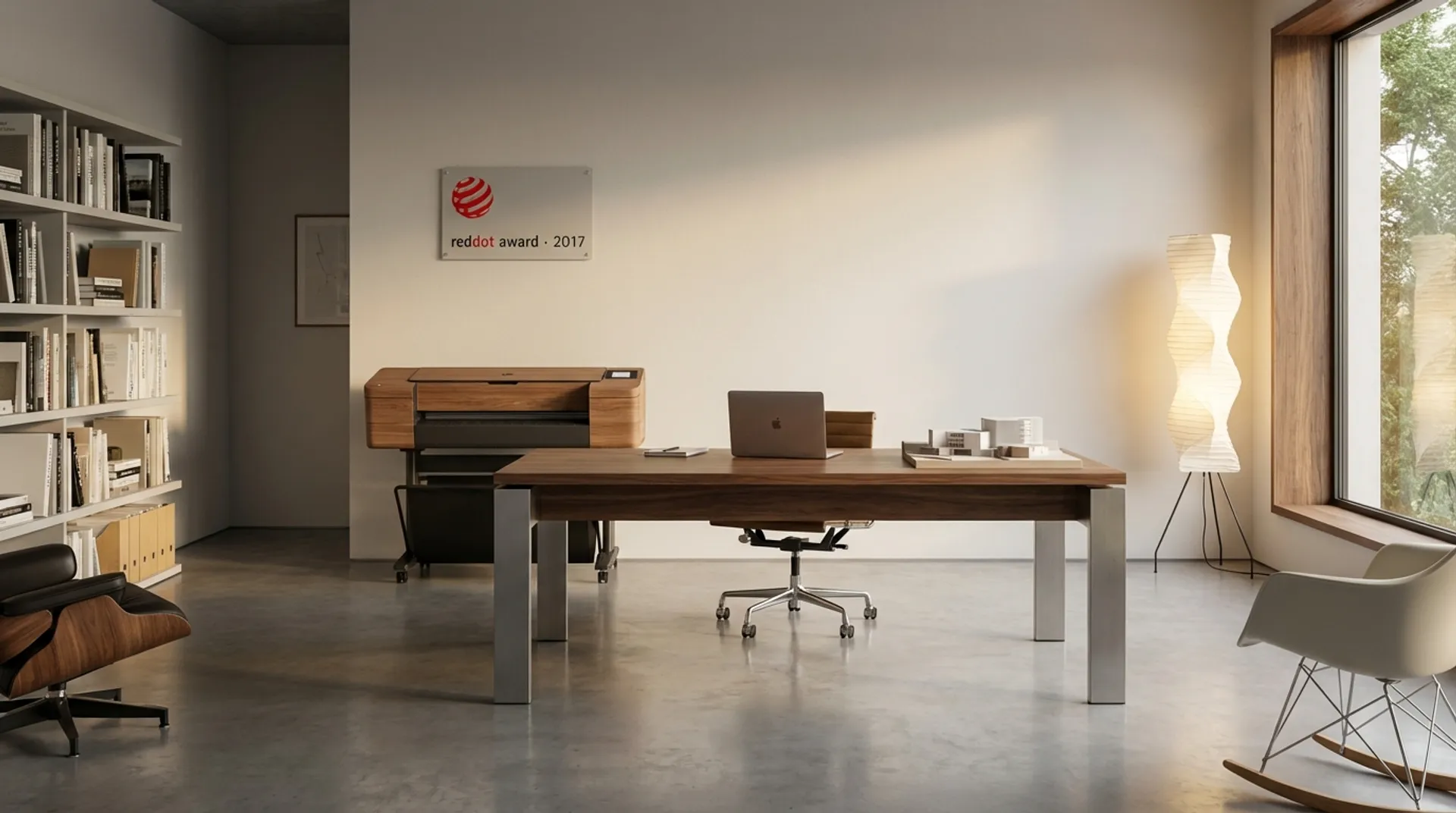
As an architect, you don’t just sell bricks and concrete; you sell vision, aesthetics, and experience. Your office is your calling card. Why then should this carefully designed space be marred by a bulky, gray machine with hanging cables? HP has understood this. The HP DesignJet Studio series didn’t win the prestigious Red Dot and iF Design Awards for nothing. It is the first plotter that hides technology and celebrates design, made of steel, wood, and carbon-neutral plastic. In this blog, we discuss why design is not superficiality, but a fundamental part of your professional appearance.
Invisible Technology in the Modern Office
In traditional engineering firms of the ’90s, it didn’t matter what a plotter looked like. It stood in a separate room, far away from clients, humming and rattling. But times have changed. Architecture firms are now open spaces, ateliers where creativity flows and where clients come for meetings.
In such an environment, the old plotter is an eyesore:
- Gray, yellowed plastic.
- A tangle of power and network cables.
- A dusty basket where prints wrinkle.
- Noisy fans that disturb conversations.
The new HP DesignJet Studio (available in 24-inch/61 cm and 36-inch/91.4 cm) breaks this dogma. It is technology designed to be seen, or rather to blend invisibly into the interior.
The Red Dot Jury Verdict: Why is this special?
The jury of the Red Dot Award praised the “Materiality” and the “Integration”. What makes this machine different?
1. High-End Materials
Instead of cheap injection-molded plastic, the Studio series uses materials you would also find in furniture.
- Wood or Steel: You can choose a top cover with a wooden finish (“Wood”) or a sleek, white steel look (“Steel”). This makes the machine more like a sideboard or side table than a printer.
- Fabric: The collection basket is made of high-quality textile, not floppy nylon.
2. The “Uncluttered” Look
HP has thought about visual peace.
- Hidden cables: Only one power cord is visible. The power supply is tucked away internally. No blocks on the floor. Because the printer works entirely via Wi-Fi, no network cables are needed.
- Compactness: The printer is up to 38% smaller than previous models. The legs are slim and airy, keeping the space underneath open and making the room look larger.
- Closed design: When the printer is not in use, the output tray and the input tray fold shut. It is a sleek block, not an open mouth catching dust.
Sustainability as a Design Choice
In 2026, design can no longer be seen separately from ecology. Being beautiful is not enough. The design must also be ethically correct. The HP DesignJet Studio is a pioneer in the industry here.
- Carbon Neutral: HP offsets the total CO2 emissions from the production and transport of every Studio plotter (via forest conservation projects).
- Recycled Plastic: The housing contains up to 30% recycled plastic (PCR - Post-Consumer Recycled content).
- Energy Efficient: Thanks to smarter electronics and an efficient sleep mode, the machine consumes minimal power in standby.
- Design for Disassembly: At the end of its lifespan, the machine is easier to dismantle for recycling.
This fits perfectly into your story to clients: “We don’t just design sustainably, we also work with tools that respect the planet.” It strengthens your brand image.
Business Fundamentals: An Investment in Experience
Is design worth the extra cost? An office that looks good sells better.
1. Customer Experience
Imagine: A client enters your studio. You discuss their dream project. On the spot, you send a render from your iPad to the plotter. The machine, which looks like a piece of designer furniture, begins to print whisper-quietly. The client sees their house appearing on high-quality paper. This is magic. This is professionalism. It confirms the trust that you have an eye for detail and quality.
2. Employee Satisfaction
A pleasant working environment increases productivity and creativity.
- No one likes working next to a noisy machine. The silence (up to 45 dB in operation) provides peace.
- The ergonomics of the Auto-Sheet Feeder (automatically switching between A3 and A0) prevents frustration when changing paper.
TCO and Value Retention
Design products retain their value better. A worn-out gray plastic printer is worth nothing after 5 years. A well-maintained HP DesignJet Studio remains a sought-after object, even on the second-hand market for starting architects.
Media & Supplies: The finishing touch
The aesthetics don’t stop at the outside of the machine. The output must be commensurate. You can’t arrive with a dull print on thin paper.
- HP Premium Satin Photo Paper: Use this for renders. The satin finish gives depth to shadows and lets glass parts in your design shine.
- HP Bright Office Inks: These inks were specifically developed for this segment. They offer deep blacks (for sharp lines) and very vivid colors (for visualizations), even on ordinary paper.
- Presentation Folders: Since the machine often combines A3 (via the tray) and A1 (via the roll), you can create complete presentation sets in one corporate style.
Europlan Service
We don’t just deliver a box. Design comes with a white glove service.
- Placement: Our installers place the machine exactly where you want it, level and stable.
- Cable Management: We ensure that single power cable is neatly tucked away.
- Recycling: We take all packaging materials (polystyrene, cardboard, plastic) back with us. Your office is immediately ready for use, without the mess.
Conclusion: Form follows Function
The adage of modern architecture also applies to your tools. The HP DesignJet Studio proves that function and form go hand in hand. You are an architect. You know that details matter. Every socket, every plinth, every shadow joint is well thought out. Choose a plotter that reflects your eye for detail.
Ready to give your office the upgrade it deserves?
Read also
- Product/Solution: view our archive scanners