
Summary: The Business Case in Short
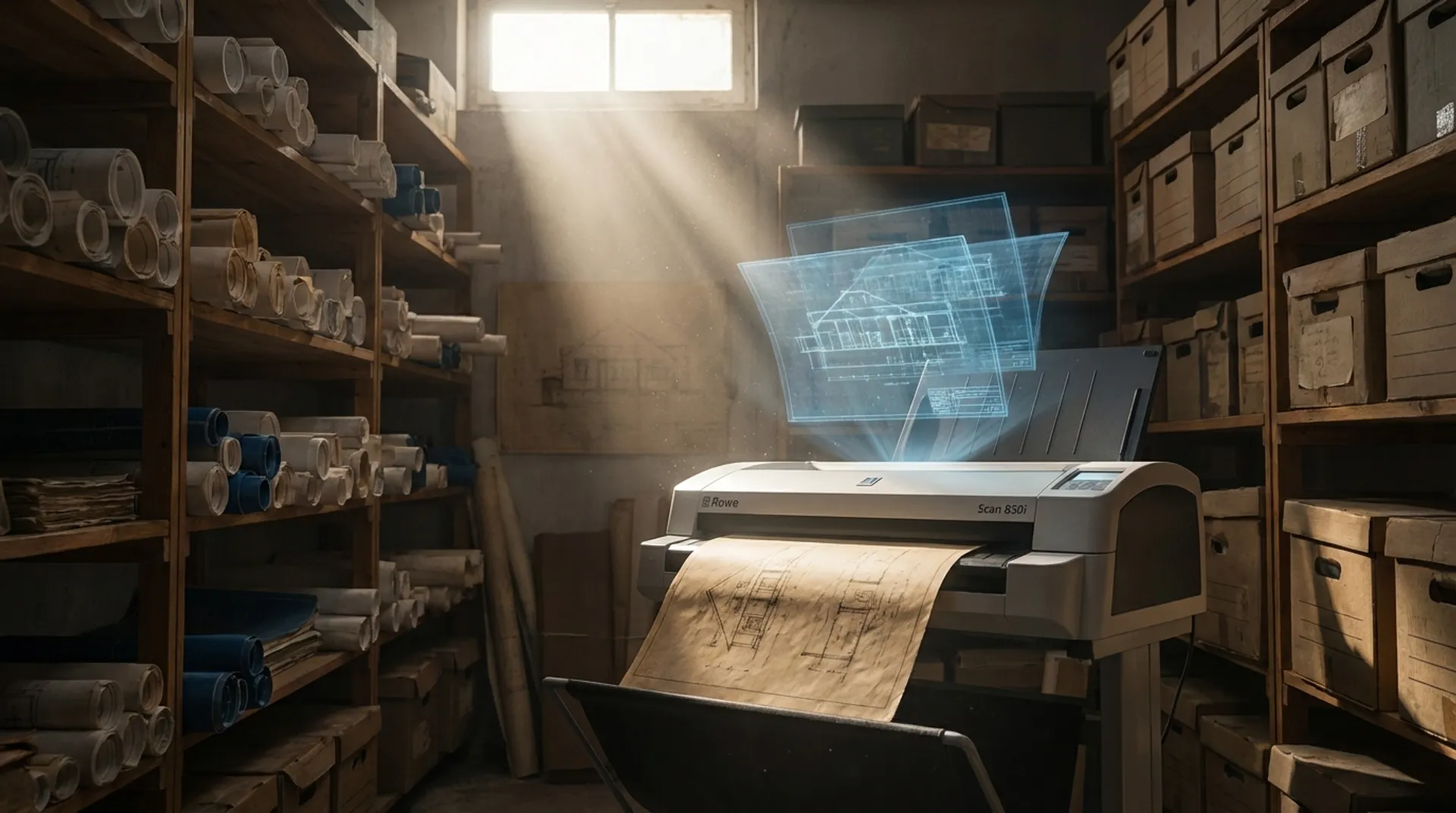
Every municipality, every old architecture firm, every utility company, and every production company in Belgium has one: “The Basement”, “The Attic”, or “The Warehouse”. A ‘forgotten’ space full of dusty rolls, hanging folders, and steel drawer cabinets. Inside are thousands of old blueprints, transparent tracings, and cadastral maps from the ’50s, ’60s, and ’80s.
These documents are often crucial (legal proof of ownership, exact location of underground pipes, construction details of historical buildings), but they are slowly decaying. They are chemically unstable, hard to find (“Search in box 45”), and take up expensive square meters.
Digitization is hot. “Digital Transformation” is on everyone’s agenda. But scanning thousands of fragile A0 drawings is arduous, risky, and specialized work. There is a huge, profitable opportunity here for repro houses, archive services, and facilities companies. With the Rowe Scan 850i / 650i / 450i, you can set up this service professionally and scalably.
The Value of Digital (Why now?)
Why do companies want to pay for digitization now? What is the ‘driver’?
- Real Estate Prices (Space is Money): Office space in cities like Brussels, Antwerp, or Genk easily costs € 150 - € 300 per m² per year. An archive room of 50 m² thus costs a company € 7,500 to € 15,000 per year, just for base rent. A hard drive or cloud storage (Azure/AWS) costs a fraction of that. Digitizing pays for itself through the freed-up space that gets a useful repurposing (workplaces, meeting rooms).
- Accessibility & Findability (Searchability): A well-known Murphy’s Law: If you need an old drawing from 1985 (e.g., for a renovation permit or leakage), it’s lost, misfiled, damaged, or lent to a colleague who no longer works there. A digital archive is searchable (OCR on the title block) and accessible to everyone 24/7 in the cloud, from the workplace, home, or on site via a tablet.
- Preservation (Conservation): Paper acidifies, ink fades, and blueprints (Ammonia prints) slowly become unreadable due to exposure to light and air. Digitizing is preserving (“Preservation through digitization”). If the original crumbles in 10 years, you still have the digital copy as a legally reliable document (if you scan according to guidelines).
The Challenge: Fragility (Old Paper)
Old drawings are extremely fragile. This is why clients don’t “just do it themselves” on their multifunctional office printer.
- Tears: A standard scanner with hard “pinch rollers” (rubber wheels that grab and pull the paper) can tear an old, brittle tracing or vellum drawing into strips. Irreparable damage to unique heritage.
- Folds and Creases: Maps have often been folded in folders for years. The fold lines give deep, black shadows on the scan, making text or lines on the fold unreadable (OCR fails).
- Low Contrast: Authentic blueprints are dark blue with white lines. After 50 years, they are often pale blue with light gray lines. A regular scanner no longer sees the difference (“Gray on gray”).
The Solution: Rowe Scan (Made in Germany)
The German manufacturer Rowe has developed scanners specifically for this delicate archive work. They are the standard in museums, libraries, and city archives worldwide.
1. Rowe Safe Drive (Safety first)
The paper transport is uniquely patented. There are no aggressive wheels that pull.
- The transport system “petals” the paper instead of grabbing it.
- Even if a drawing is partially torn, taped together, or has “dog ears”, it goes through safely and flat.
- The scanner automatically recognizes the width (Auto-Size) and starts.
- ROI argument: You can guarantee to the client (e.g., the city archive) that their unique documents will not be damaged. This is a hard requirement in tenders.
2. Rowe Pro Logic (Intelligent Image Enhancement)
The software is the brain. Rowe scans in one go (One Pass) and analyzes during scanning what kind of document it is.
- Blueprint Mode: Is it a blueprint? It increases the contrast locally and inverts the colors (white on blue automatically becomes black on white for better readability).
- Transparency Mode: Is it parchment or vellum? It removes the yellowness (Background Noise) (“Despeckle”).
- Double Lens Technology: Special LED lighting shines from different angles. This literally “lights away” (shadow-free) folds and creases, comparable to studio light in photography.
3. Speed and Quality
- Resolution: Up to 2400 x 1200 dpi (optical). You can zoom in down to the fiber structure of the paper.
- Speed: Scans up to 18 meters per minute in color. You scan an archive box in an hour, instead of a day.
Business Fundamentals: The Business Model
You don’t sell digitization per hour, but per object (per m² or per drawing).
- Market Price: One A0 scan of high archive quality (incl. indexing, straightening, cropping, and naming) goes for between € 2.50 and € 7.50 in the market (depending on volume and the physical state of the original).
- Productivity: With a Rowe Scan and the right software (ScanManager), an experienced operator does 60 to 100 scans per hour (including picking up and putting back the drawing).
- Revenue Potential: 60 scans x avg. € 4.00 = € 240 per hour revenue per operator/machine.
- The machine (investment around € 10,000 - € 15,000) is fully earned back after a single large archive project (e.g., from a municipality, hospital, or housing association). After that, it’s pure profit. The operational costs (power) are negligible.
Europlan Service: More than the box
We deliver more than just the hardware (“Box moving”). We help you set up the service.
- Workflow Training: How do you handle historical documents? Which resolution (TIFF/PDF/A) is the standard for archives (PDF/A-2b)? How do I index conveniently without typos?
- Software Options: Rowe ScanManager software helps with automatic file naming.
- E.g., via OCR: The software reads the text “Project 1234” in the title block of the drawing and automatically names the file
1234_drawing_01.pdf. This saves hours of typing.
- E.g., via OCR: The software reads the text “Project 1234” in the title block of the drawing and automatically names the file
- Maintenance: We calibrate the scanner annually and replace the glass plate and transport rollers if they are scratched by staples or paperclips, to maintain optimal sharpness.
Conclusion: Become the Guardian of History
Your clients are sitting on a goldmine of data but can’t access it. With Rowe Scan technology, you unlock that value. You offer them peace of mind (backup), space (clearing out), and certainty. And you create a very profitable, stable new branch for your company that is not sensitive to daily deadline stress.
Do you want to see how we save and digitally restore a torn blueprint from 1950?
Read also
- ESG and Circular Economy: Is Your Print Fleet Ready for the 2026 CSRD Standards?
- Managed Print Services (MPS): Why You No Longer Want to Pay for a Printer
- Product/Solution: view our large-format scanners
Come by with your oldest, ugliest drawing for a free scan demo and convince yourself