
Summary: The Business Case in Brief
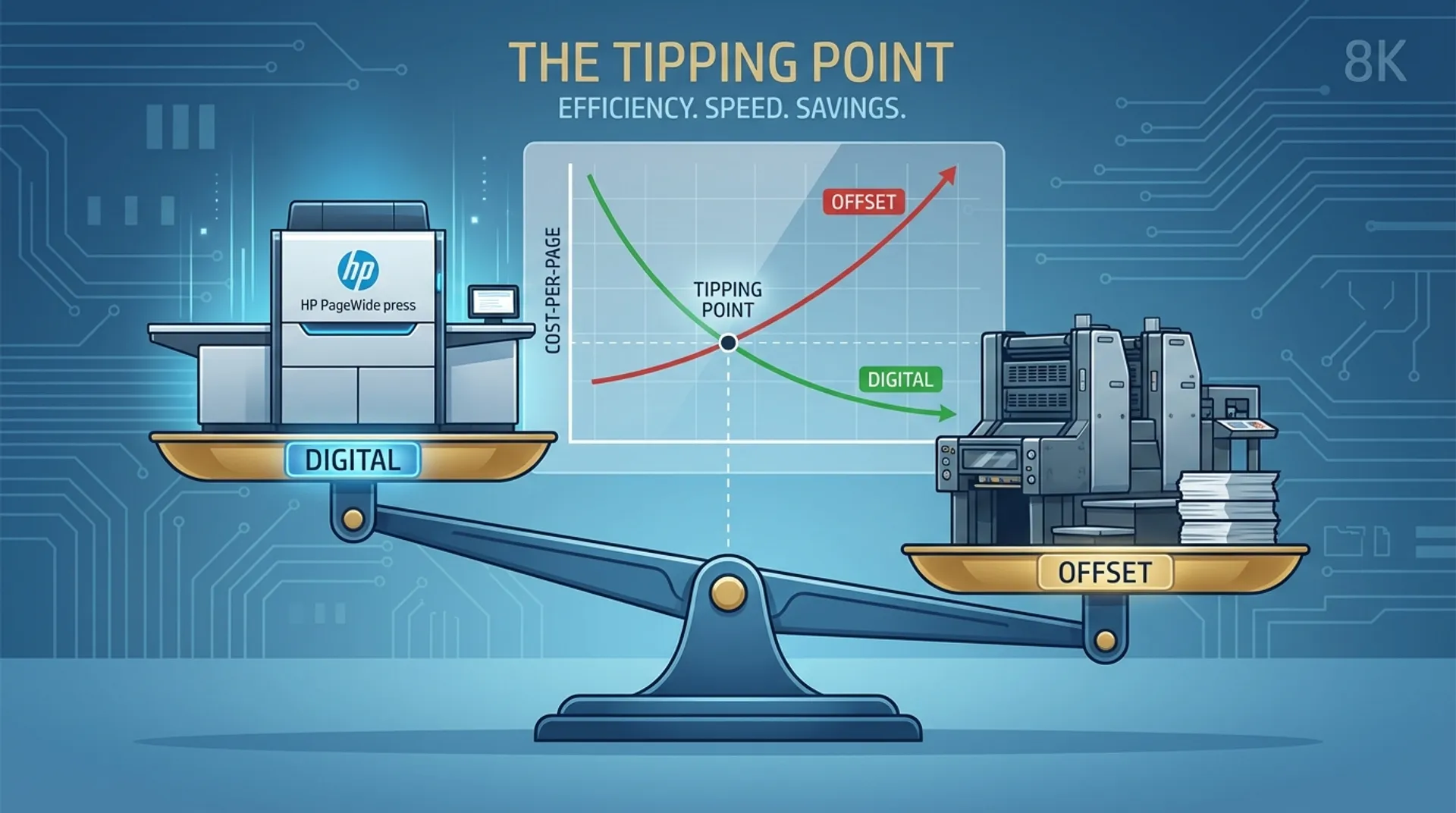
In the graphic world, the debate between offset and digital is a classic. Offset is king for huge volumes; digital wins in personalization and speed. But where exactly is the tipping point? Thanks to the arrival of industrial powerhouses like the HP PageWide XL Pro 10000, that point has shifted radically. Where previously orders of 500 pieces automatically went to the offset press, today it is often more economical to produce up to 2,500 or even 5,000 copies (depending on the format) digitally. This article analyzes the factors that determine this ROI and how you can minimize your production costs per m².
The Cost Structure: Setup Costs vs. Variable Costs
To understand the tipping point, we must look at the structure of the costs.
1. Offset: The High Threshold
With offset, the setup costs (pre-press, plate making, setting up the press) are high. Whether you print 1 or 10,000 posters, those initial fixed costs remain the same. However, once the press is running, the variable costs per sheet are extremely low.
2. Digital: The Linear Approach
Digital printing has virtually zero setup costs. You press ‘print’ and the first poster is perfect. However, the variable costs (ink and printhead wear) remain the same, whether you print 10 or 1,000.
Shifting the Tipping Point: The PageWide XL Pro Factor
Machines like the HP PageWide XL Pro 10000 change the dynamics.
- Speed: With speeds up to 1000 m² per hour (or 20 A1 posters per minute), digital approaches the productivity of an offset press for medium-sized runs.
- No Plate Costs: The elimination of plate costs means that the ‘fixed’ cost component of offset disappears per job.
- Variable Data: Digital allows you to make each poster unique (e.g., different addresses or promo codes) at no extra cost. Offset cannot do this.
Business Fundamentals: ROI Analysis
What are the decisive factors for your margin?
- Downtime: An offset press requires time for a ‘change-over’ (changing plates, color settings). Digital switches between jobs on different media in seconds.
- Storage Costs: With offset, it is often printed in excess ‘just to be sure’ to lower the unit price. The stock that is not used is pure loss. Digital makes ‘Print on Demand’ possible.
- Hectic Work Schedule: Customers demand ‘Same Day Delivery’. Offset can rarely achieve this profitably for small to medium-sized runs.
Media & Supplies: From Paper to Cardboard
The PageWide XL Pro series excels in versatility. Where traditional digital printers are often limited to roll media, the Pro 10000 easily prints on cut-sheet material and even on rigid boards (up to 10 mm thick). This opens up markets (such as POS displays and presentation panels) that were previously exclusively the domain of screen printing or specialized offset presses.
Europlan Service: Calculating Your Tipping Point
We help you make the right choice for your investment.
- Job-Costing Analysis: We take your most common jobs and calculate the production costs on an HP PageWide XL Pro vs. your current systems.
- Workflow Optimization: We implement software that automatically determines which job should go to which machine for maximum margin.
- Leasing Models: For production environments, we offer lease options based on volume, ensuring your costs move linearly with your revenue.
Conclusion: The Digital Catch-Up
The tipping point is inexorably shifting towards digital. The flexibility, low entry costs, and increasing speed make the HP PageWide XL Pro series the ideal replacement or addition for traditional printing methods. Those who stick to old calculation models are leaving margins on the table.
Would you like an expert to run your own ‘break-even’ analysis?